A tree can be the difference between a front yard that feels merely maintained and one that feels like home. In Shreveport, Bossier City, Benton, and nearby communities, the best trees for northwest Louisiana need to handle long, humid summers, heavy rain, occasional drought, clay soils, and surprise winter cold snaps – all while bringing welcome shade and year-round beauty.
The right choice is not always the fastest-growing tree at the nursery. It is the tree that fits your available space, drainage, sunlight, and plans for the property five, ten, and twenty years from now. A well-placed tree is a lasting investment in curb appeal, comfort, and the character of your outdoor living space.
What Northwest Louisiana Trees Need to Handle
Northwest Louisiana gives trees a demanding but generous growing environment. Our hot summers can stress shallow-rooted selections, while compacted clay soil can hold water after a storm and become very hard when dry. Many local properties also have pockets of standing water, utility lines, tight suburban lots, or existing irrigation to consider.
Before choosing a tree, look at the site rather than the tag alone. A shade tree planted too close to a driveway will eventually lift concrete. A moisture-loving tree planted in a dry, unwatered corner may struggle from its first summer. And a tree that grows beautifully in an open field may be too large for a courtyard or foundation bed.
A thoughtful plan accounts for mature height and spread, overhead power lines, underground utilities, rooflines, drainage patterns, and the amount of leaf or fruit drop you are willing to manage. That kind of planning is what keeps a beautiful new planting from becoming an expensive correction later.
The Best Trees for Northwest Louisiana Properties
Nuttall Oak
For a large property, the Nuttall oak is one of our favorite long-term shade trees. It grows into a strong, stately canopy and is better suited to heavier, sometimes moist Louisiana soils than many other oaks. Its leaves turn shades of red and bronze in fall, giving homeowners a little seasonal color without sacrificing the substantial summer shade that makes outdoor spaces more usable.
This is not a small-yard tree. Give it plenty of room away from structures, driveways, and patios. A Nuttall oak is a choice for someone planting for future family gatherings, shaded lawn space, and a landscape that becomes more handsome with age.
Bald Cypress
Bald cypress has a distinctly Southern presence, with soft, feathery foliage that turns warm copper before dropping in fall. It performs especially well in low areas and soils that stay wet after rain, making it a smart solution where other shade trees may decline.
Despite its association with water, bald cypress can also adapt to average landscape conditions once established. Its roots may develop “knees” in very wet settings, so it is best set back from walkways and mowed turf where those natural features could be inconvenient. In the right spot, it offers graceful texture and impressive resilience.
Live Oak
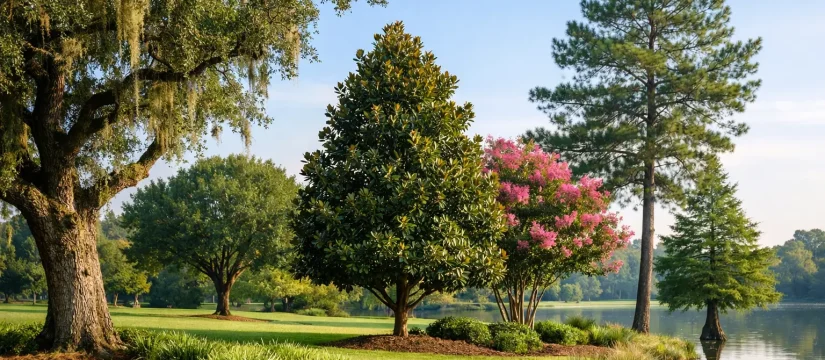
A live oak gives a property an unmistakably classic Southern look. Its broad, evergreen-to-semi-evergreen canopy provides generous shade, and its sturdy form can anchor a front lawn or expansive backyard beautifully.
In our part of Louisiana, live oaks benefit from a protected location and enough room to mature. They are better suited for larger lots than narrow planting strips, and they should never be crowded against a house. If you have the space, a live oak can become the tree everyone associates with your home.
Southern Magnolia
For evergreen privacy, glossy foliage, and fragrant white blooms, Southern magnolia remains a timeless choice. It works particularly well as a specimen tree near an entry, at the edge of a lawn, or as a soft screening element where you want a more polished, layered look.
Magnolias do shed leaves, seed pods, and occasional petals, so they are not the lowest-maintenance option beside a pool or freshly swept patio. Still, their beauty more than earns their keep when their natural litter is planned for rather than treated as a surprise. Choose a compact cultivar when space is limited.
Willow Oak
Willow oak is an elegant shade tree with narrow leaves that create a finer texture than many traditional oaks. It has a rounded canopy, dependable shade, and good landscape appeal for homes, commercial entries, and larger common areas.
It prefers well-drained soil and regular water while establishing, especially during hot summers. Avoid placing it in a location that stays soggy for long periods. With room to develop, it offers the familiar strength of an oak without such a coarse, heavy appearance.
Eastern Redbud
Eastern redbud brings one of spring’s happiest moments: branches covered in rosy pink to lavender blooms before the leaves emerge. It is ideal for smaller yards, foundation beds, woodland edges, and spaces where a full-size shade tree would overpower the landscape.
Redbuds generally prefer morning sun or filtered light and benefit from protection from the harshest afternoon exposure. They are beautiful as individual specimens or planted in a small grouping for a more natural, layered garden effect. Their heart-shaped leaves and graceful branching give a property charm in every season.
Yaupon Holly
Yaupon holly is a versatile native evergreen that can be trained into a small tree or allowed to grow as a large screening shrub. Female plants produce bright red berries that add winter color and support birds, while the dense foliage creates privacy without feeling formal or stiff.
This is an excellent option for tighter spaces, side yards, and areas near patios where a massive canopy would be impractical. It handles heat and humidity well and brings reliable structure to a landscape when other decididuous trees are bare.
Crape Myrtle
Crape myrtles are popular for good reason: they bloom during the height of summer, offer attractive bark, and fit comfortably in many residential landscapes. They are especially effective near driveways, along property edges, or in sunny beds where a smaller ornamental tree is needed.
The trade-off is maintenance. Crape myrtles can develop pests such as bark scale, and aggressive annual topping creates weak, unattractive growth. Select a cultivar sized for the space, then use selective pruning to preserve its natural shape. A properly maintained crape myrtle should look graceful, not chopped back.
Black Gum
Black gum, also called tupelo, is an underused choice for homeowners who want outstanding fall color and a more refined native tree. Its glossy leaves can turn vivid red, orange, and purple, and its form remains attractive even in winter.
It prefers acidic, consistently moist but well-drained soil. That means it may not be the simplest choice for every compacted clay yard, but it can be exceptional where drainage and soil conditions are right. It is a lovely alternative to the more predictable red maple.
Mexican Plum
Mexican plum is a small native tree with fragrant white spring flowers, edible small plums, and warm fall color. Its smaller mature size makes it a wonderful choice near a patio, in a pollinator-friendly garden, or as part of a layered planting around a larger shade tree.
It is not a perfectly tidy tree, and fallen fruit may not suit every location. Keep it away from sidewalks and high-traffic hardscape, then let it add seasonal personality to a garden bed or naturalized edge.
Plant for the Mature Tree, Not the Nursery Pot
Even the best selection can fail when it is planted too deeply or watered poorly in its first year. The root flare, where the trunk begins to widen into roots, should sit at or slightly above the finished grade. Planting too deep is one of the most common reasons young trees decline.
A wide planting hole is more helpful than an overly deep one. Backfill with the native soil unless a site-specific soil issue calls for a different approach, then create a broad mulch ring with mulch kept a few inches away from the trunk. Piling mulch against bark, often called a mulch volcano, holds moisture where it does not belong and can encourage disease and pests.
Water deeply and slowly after planting, then continue consistently through the first growing season. New trees need moisture in the root zone, not a quick daily sprinkle across the lawn. Irrigation can make establishment much easier, but it should be adjusted for rainfall and soil type rather than set and forgotten.
A More Welcoming Yard Starts With the Right Tree
Trees should solve a need as well as create beauty. A Nuttall oak may shade the western side of a home. A bald cypress may bring order to a persistently wet corner. A redbud or Mexican plum may make a modest front garden feel more personal and inviting.
At Front Porch and Garden, we encourage homeowners to think of tree selection as part of the whole property – lawn health, drainage, garden beds, patios, views, and the way your family actually uses the space. Choose a tree with care, give it room to grow, and it will return that attention through every season spent beneath its branches.